Appearance
| Foals | 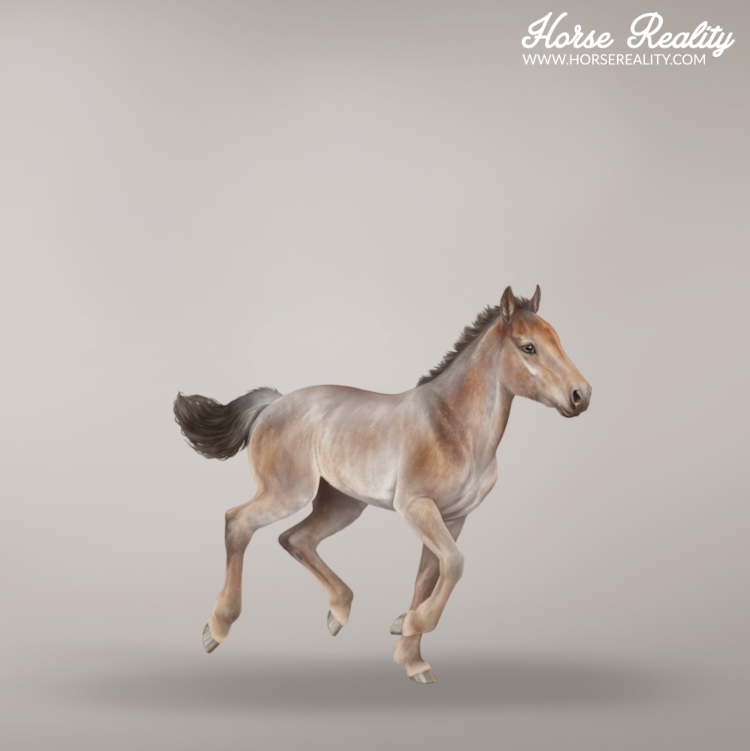 |
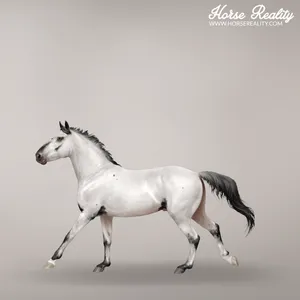
Foals are usually born solid and start getting more white hairs in their coat over time. When they start and the speed at which they "varnish out" can vary a lot. Foals can already show mottled skin, striped hooves and white sclera. They may lack foal camo and show goggles similar to grey horses. |
|---|
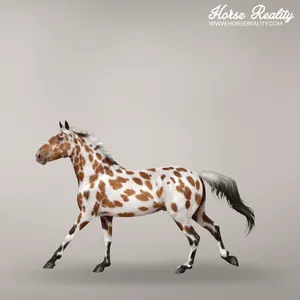
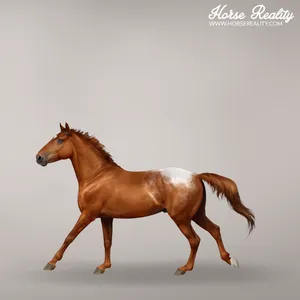
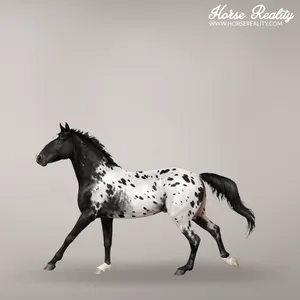
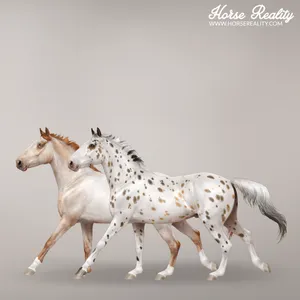
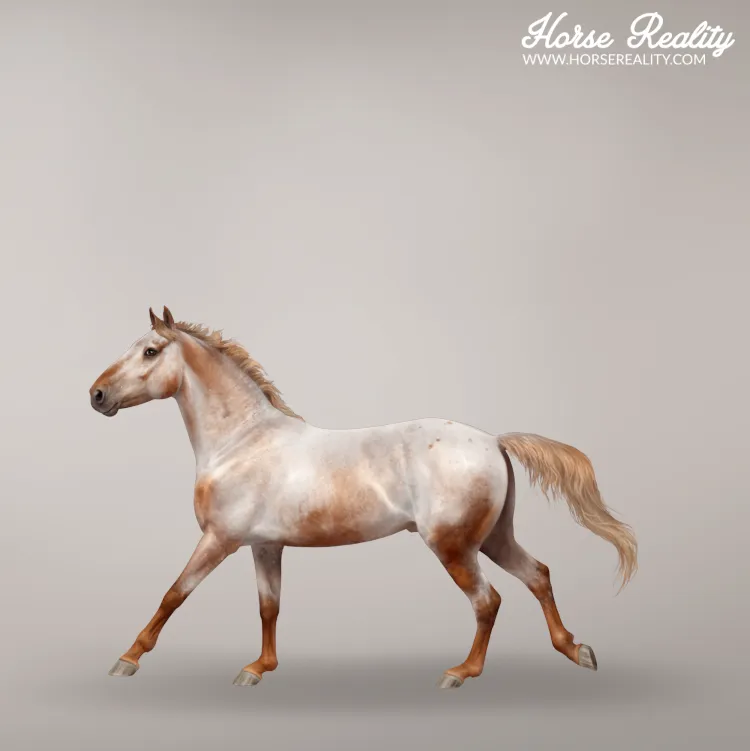
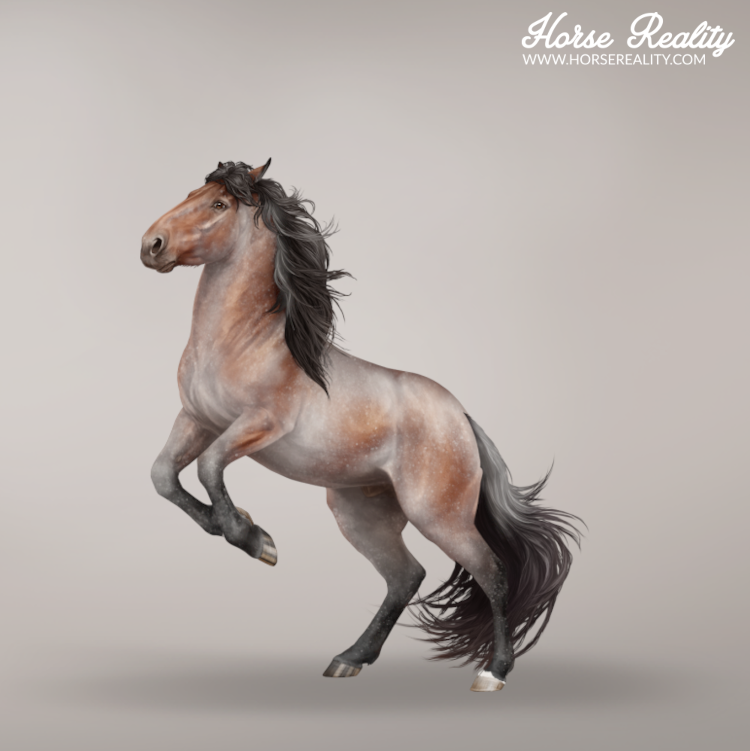
Varnish roan horses have white hairs mixed into their coat. The amount of white tends to increase over time and may also change seasonally. It avoids the bony areas of the horse (nose bridge and cheek, often resulting in a typical V-shape; points of the hip, shoulder, knees and hocks), which stay colored. Horses have mottled skin, striped hooves and white sclera. |
 |
Adults |
|---|
Mimics
Varnish roan could be confused with roan. Even though they both have "roan" in the name, they are completely different patterns on two different genes (roan is located on KIT). They can look similar, however!
Varnish roan also shares a lot of characteristics with grey, as they can both gradually lighten the coat with age.

Roan causes white ticking all over the body, but (generally) doesn't cover the head and lower legs, causing an inverted V-shape where the solid legs meet the roaned body. The pattern may change seasonally, but it doesn't increase over time.
Grey gradually lightens the entire coat to white.
Varnish roan avoids the bony areas of the horse and also features striped hooves, white sclera etc. The amount of white tends to increase with age.
Genetics
Varnish roan is the result of one or two copies of the LP-allele, without any PATN1 or other modifying alleles. LP is a dominant allele of the gene.
Some horses only test positive for LP, without any PATN1, yet they have patterns like spotted blankets or snowcaps. There are likely (many) other alleles that affect how spotted patterns are expressed we haven't identified yet.
Therefore, in our game, Horse Reality, we use PATN2 as an extra (untestable) modifier that can cause small blankets etc. The existance of PATN2 was once theorised, but was never proven.

Varnish roan:
LP/lp or LP/LP
Articles
- Bellone RR, Holl H, Setaluri V, Devi S, Maddodi N, Archer S, Sandmeyer L, Ludwig A, Foerster D, Pruvost M, Reissmann M, Bortfeldt R, Adelson DL, Lim SL, Nelson J, Haase B, Engensteiner M, Leeb T, Forsyth G, Mienaltowski MJ, Mahadevan P, Hofreiter M, Paijmans JL, Gonzalez-Fortes G, Grahn B, Brooks SA; Evidence for a retroviral insertion in TRPM1 as the cause of congenital stationary night blindness and leopard complex spotting in the horse; PLoS One (2013); Doi: 10.1371/journal.pone.0078280
- McFadden A, Vierra M, Martin K, Brooks SA, Everts RE, Lafayette C; Spotting the Pattern: A Review on White Coat Color in the Domestic Horse ; Animals (2024); Doi: 10.3390/ani14030451
- Terry RB, Archer S, Brooks S, Bernoco D, Bailey E; Assignment of the appaloosa coat colour gene (LP) to equine chromosome 1; Animal Genetics (2004); Doi: 10.1111/j.1365-2052.2004.01113.x
Learn while playing! Discover how genes shape colors and patterns in our realistic horse breeding game, Horse Reality