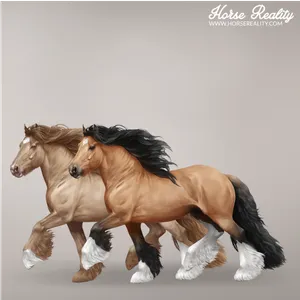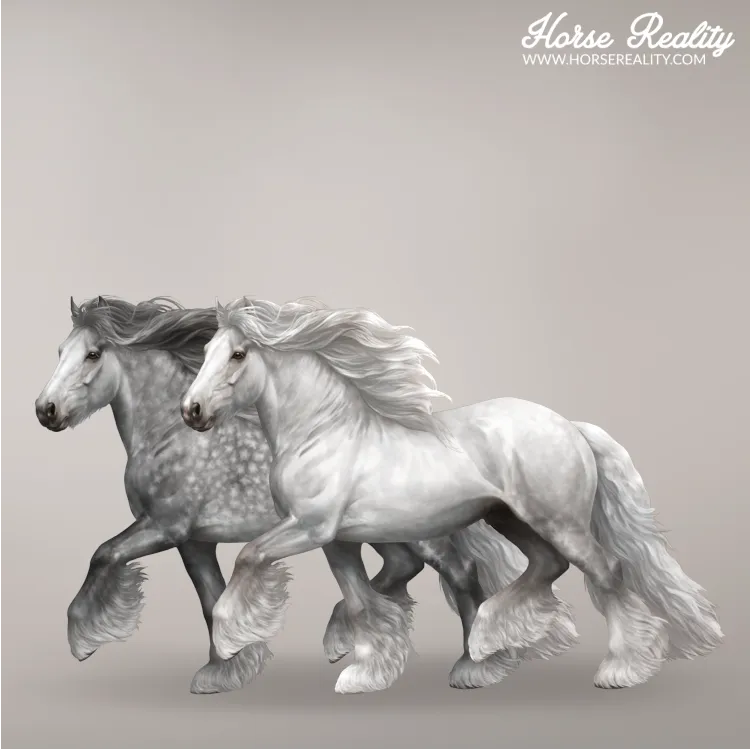
The STX17 (Syntaxin 17) gene is a gene that influences coat color in horses.
Alleles
The STX17 gene has three currently known alleles that influence coat color.
The dominant G3-allele (grey) causes a lightening, or greying, of the coat over time. It also leads to a higher risk of developing melanoma and depigmentation.
The dominant G2-allele (grey) also causes greying of the coat over time, but the greying is slower and often only happens later in life. The risk of melanoma is also lower.
The recessive g-allele leads to a regular coat color without greying.
| STX17 | Color |
| Grey | |
| Grey | |
| Grey | |
| Grey | |
| Late greying | |
| Not grey |
Mechanics
Pigment cells, called melanocytes, produce the pigments in the hair and skin of horses. The production of pigments can be influenced at different stages, changing the type (black or red) or the amount of pigment that is made.

The production of black and red pigment involves several different steps. Some of these steps are shared between the two, and some are unique to each pigment type. This is why certain genes will affect all base colors, while others only affect either red or black pigment: they affect different steps.
STX17
The STX17 gene produces the STX17 protein. This protein essentially helps different parts of a cell fuse with each other. These connections make it possible to move molecules or proteins to where they are needed, and they allow special cell parts to take in and clean up any damaged molecules or cell organelles.
In horses with the G2 allele, a part of the STX17 gene is duplicated: the DNA sequence is repeated two times. In the case of the G3 allele, there are 3 copies of this sequence.
Having a higher number of copies enhances the activity of STX17 in the melanocytes. This increase in activity causes the melanocytes to survive longer and produce more pigment than normal, leading to hyperpigmentation in foals. Over time, however, if the melanocytes stay active for too long instead of getting cleaned up and replaced, they eventually get damaged, "burn out", and stop being able to produce any pigment. The result is a horse that turns grey/white over time, and that may develop vitiligo-like depigmention. Because damaged melanocytes can just keep dividing, this also leads to an increased risk of developing tumors called melanomas. The more copies of the STX17 sequence a horse has, the stronger the effect: G3/G3 horses grey faster and have a higher risk of melanomas, while G2/g horses grey out later in life and have a lower risk.
Because genetic tests only measure the number of copies a horse has, we can't distinguish between horses that are G3/g and G2/G2. In both cases, there are four copies of the STX17 sequence.
| Alleles | Mutation | Effect |
| Triplication | Fast greying and melanoma risk | |
| Duplication |
Slow greying and melanoma risk | |
| / | No greying |
Melanomas
Melanomas show up as grey "lumps" under the tail, around the genitals or on the head (eyes, mouth, jaw). Up to 80% of grey horses > 15 years old develop melanoma in their lifetime.
They are usually benign at first, not causing any problems other than aesthetics. However, they can also become malignant (cancerous), spread to other parts of the body and impact the welfare of the horse. Therefore, it is important to monitor any melanoma your horse may have.
Colors
 Hannelore Roodhooft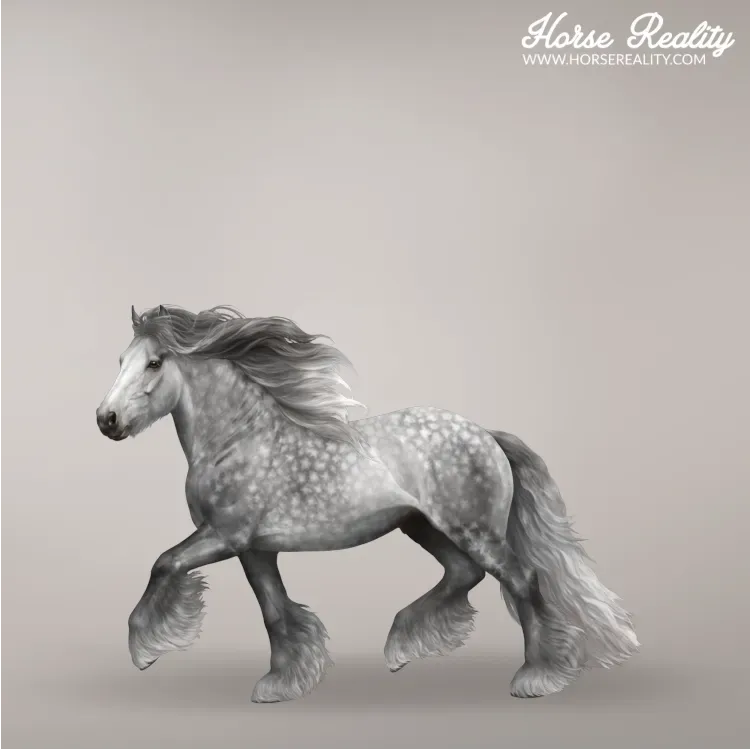
Read more:
Color genes
Articles
- Andersson L. White horses - non-coding sequences drive premature hair greying and predisposition to melanoma; Upsala Journal of Medical Sciences (2024); Doi: 10.48101/ujms.v129.10626
- Henner J., Poncet P.A., Guérin G., Hagger C., Stranzinger G., Rieder S.; Genetic mapping of the (G)-locus, responsible for the coat color phenotype "progressive greying with age" in horses (Equus caballus); Mammalian Genome (2002) doi: 10.1007/s00335-002-2174-7
- Rosengren Pielberg G., Golovko A., Sundström E., Curik I., Lennartsson J., Seltenhammer M.H., Druml T., Binns M., Fitzsimmons C., Lindgren G., Sandberg K., Baumung R., Vetterlein M., Strömberg S., Grabherr M., Wade C., Lindblad-Toh K., Pontén F., Heldin CH., Sölkner J., Andersson L.; A cis-acting regulatory mutation causes premature hair graying and susceptibility to melanoma in the horse; Nature Genetics (2008); Doi: 10.1038/ng.185
- Rubin C.J., Hodge M., Naboulsi R., Beckman M., Bellone R.R., Kallenberg A., J'Usrey S., Ohmura H., Seki K., Furukawa R., Ohnuma A., Davis B.W., Tozaki T., Lindgren G., Andersson L.; An intronic copy number variation in Syntaxin 17 determines speed of greying and melanoma incidence in Grey horses; Nature Communications. (2024); Doi: 10.1038/s41467-024-51898-2
- Swinburne J.E., Hopkins A., Binns M.M.; Assignment of the horse grey coat colour gene to ECA25 using whole genome scanning; Animal Genetics (2002); Doi: 10.1046/j.1365-2052.2002.00895.x