The discovery of Sunshine
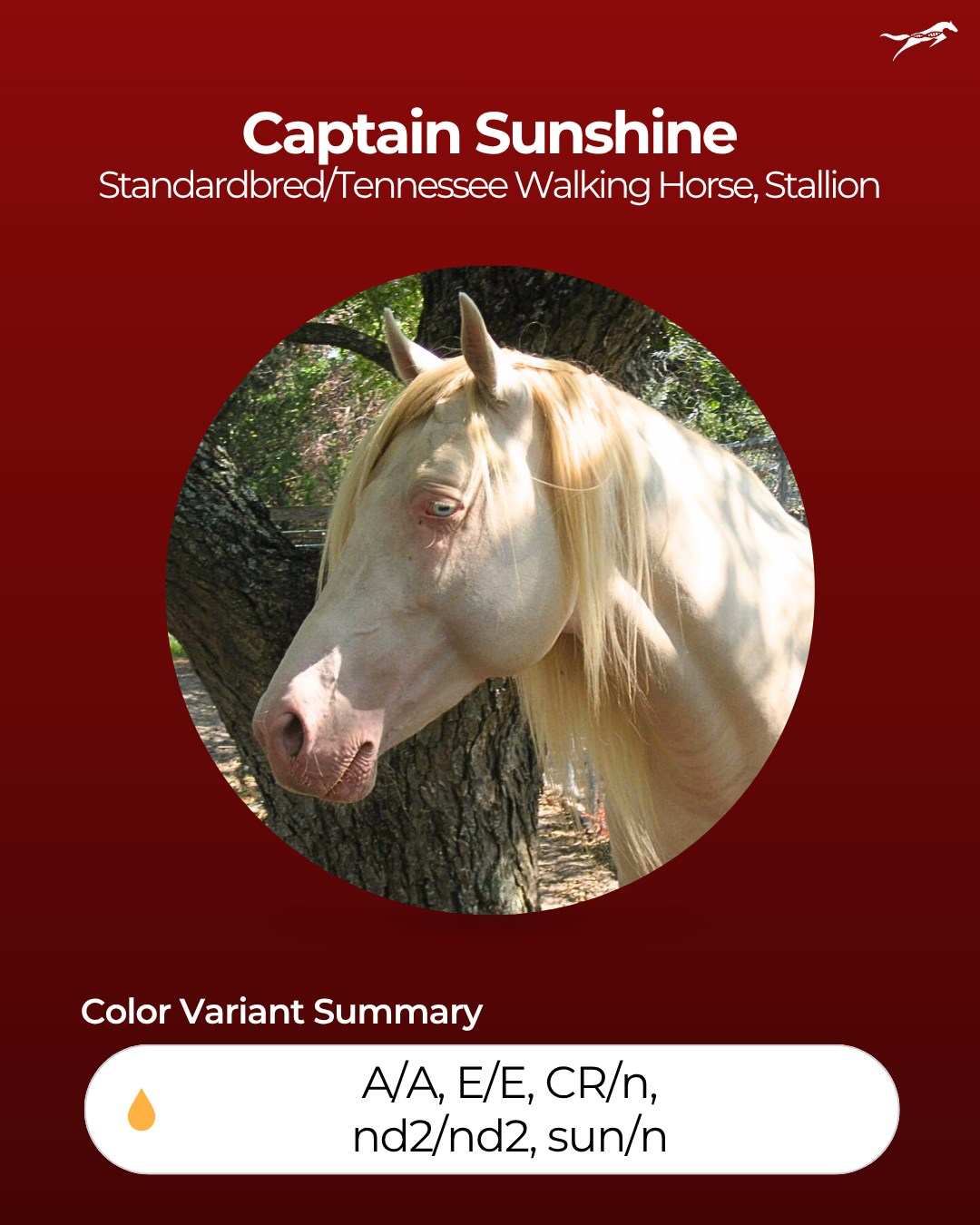
The sunshine dilution was first discovered in 2019 in the stallion Captain Sunshine. He appeared very much like a "double dilute" horse: a pale, creamy coat, mane and tail, with blue eyes. However, genetic test results from different laboratories showed that he only carried one copy of cream (CR/n), and no other known dilutions were present.
Clearly, something was going on there. Further research at Etalon Equine Genetics led to the discovery of a new dilution allele. The dilution was named sunshine, after Captain Sunshine. Sunshine (sun) is located on the MATP gene, just like the dilutions cream, pearl and snowdrop.
 |
| @Etalon Equine Genetics1 |
What Does Sunshine Do?
Not much is known yet about the effect and appearance of sunshine. Similar to pearl, a single copy of sunshine (sun/n) doesn't seem to affect the coat. In combination with one copy of cream (CR/sun, like Captain Sunshine himself), it produces a "pseudo-double dilute" color, similar to that of double cream dilutes.
We don't know yet what horses with two copies of the sunshine would look like, but it is expected to be similar to a double cream or pearl horse.
You can read the full Equinecolors sunshine article here.
A Second Sunshine Horse Appears
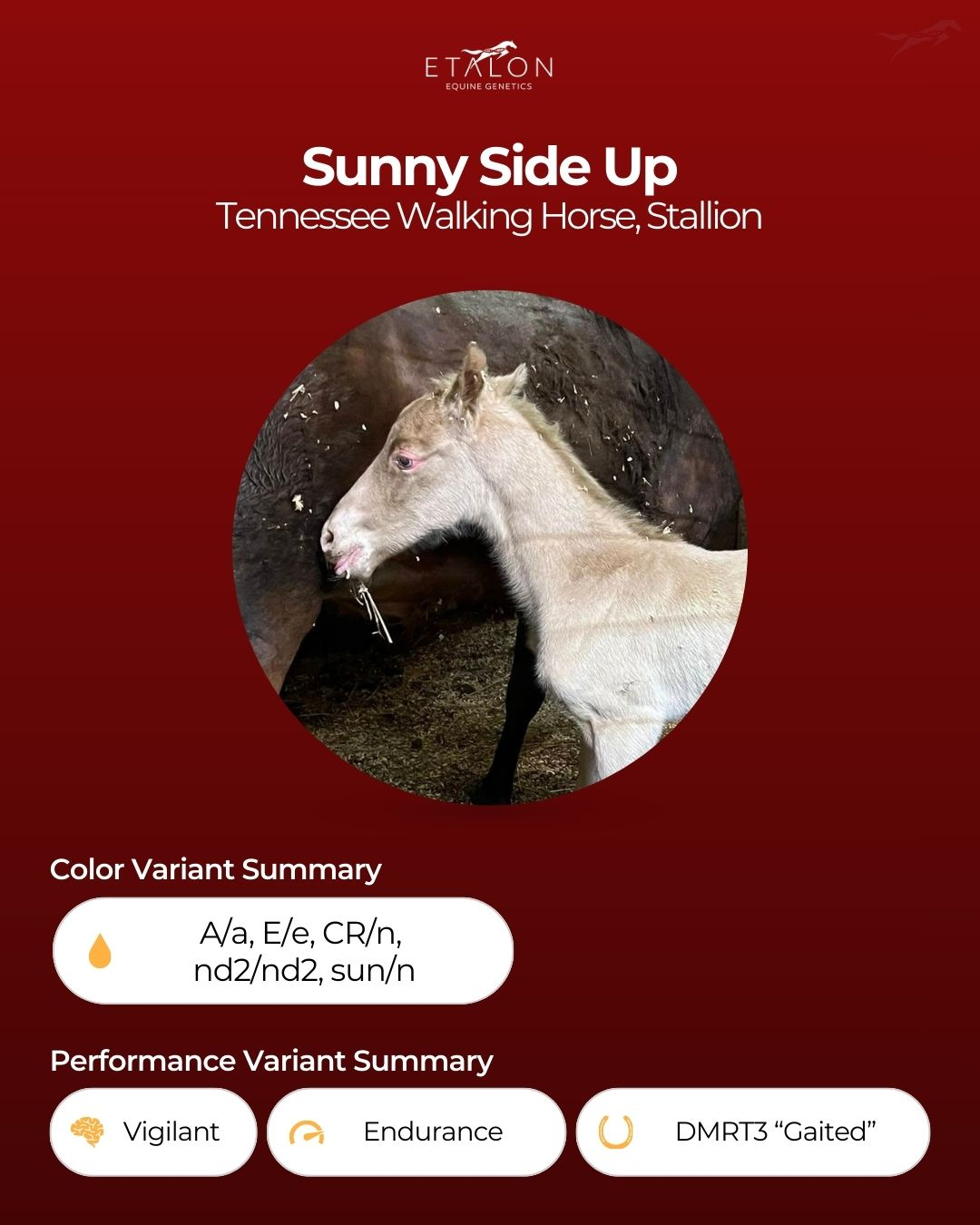
In a Facebook post on January 29th 2026, Etalon revealed that a new horse with the sunshine had been identified: the Tennessee Walking Horse colt Sunny Side Up, with a similar story to that of Captain Sunshine, tested CR/sun. His dam, a bay mare, was also found to be a sunshine carrier (sun/n).
 |
| @Etalon Equine Genetics2 |
Thoughts
There is no known relationship between the two sunshine horses. Further pedigree details are currently not available (and Captain Sunshine was a rescue, so maybe information is limited).
This does reveal, however, that Captain Sunshine is not the founder of the sunshine dilution. Both sunshine horses do have Tennessee Walking Horse lineage, so perhaps the origin of the dilution lies there. Sunshine could also possibly have originated from the Standardbred, since this breed was foundational to the TWH. If this is the case, it would make sunshine quite old!
Hopefully, this discovery will lead to more testing and more research. Now that we know it's not just present in one single family, both laboratories and horse owners might find it more interesting to test for sunshine. It's exciting to see what the future holds (will we eventually find a sun/sun horse?) and whether we can learn more about this mysterious color.
References
All images used with permission.
- Etalon Equine Genetics on Captain Sunshine:
https://www.facebook.com/etalondx/posts/pfbid02cp7udctGZUJbMCysrueLmq2nBfL5oeQJKFdM7cTsfJqEd2PU8mDpj41VtCmxE6jtl - Etalon Equine Genetics on Sunny Side Up: https://www.facebook.com/etalondx/posts/pfbid0bNMeVPuHw4y1raY38Ak2qwrqdagn2PDRUQ3ygwtdmYvg6xVy1CAKKE92hpEvJtw8l
- https://www.facebook.com/etalondx/posts/pfbid0bNMeVPuHw4y1raY38Ak2qwrqdagn2PDRUQ3ygwtdmYvg6xVy1CAKKE92hpEvJtw8l
- Backwoods Stables (breeders of Sunny Side Up):
https://www.facebook.com/permalink.php?story_fbid=pfbid0WTqrXMybM5dpPh3bH54BSA5rECmyKDHqUkFxwSm5kAtM8MaiVX2QWdzbicTVJrssl&id=61558235633107 - Etalon Equine Genetics on Sunshine:
https://etalondx.com/news-media/sunshine-mutation/ - Holl H.M., Pflug K.M., Yates K.M., Hoefs-Martin K., Shepard C., Cook D.G., Lafayette C., Brooks S.A.; A candidate gene approach identifies variants in SLC45A2 that explain dilute phenotypes, pearl and sunshine, in compound heterozygote horses; Animal Genetics (2019); Doi: 10.1111/age.12790