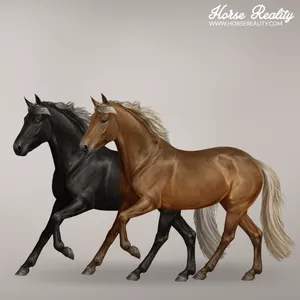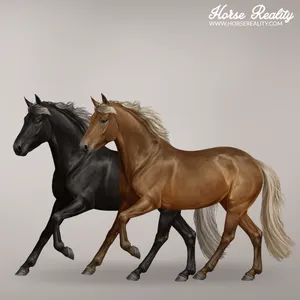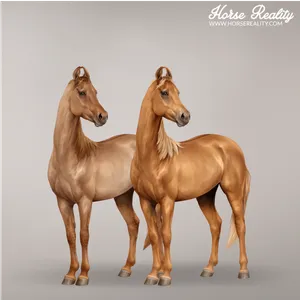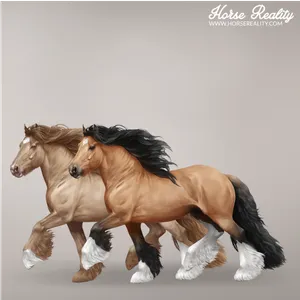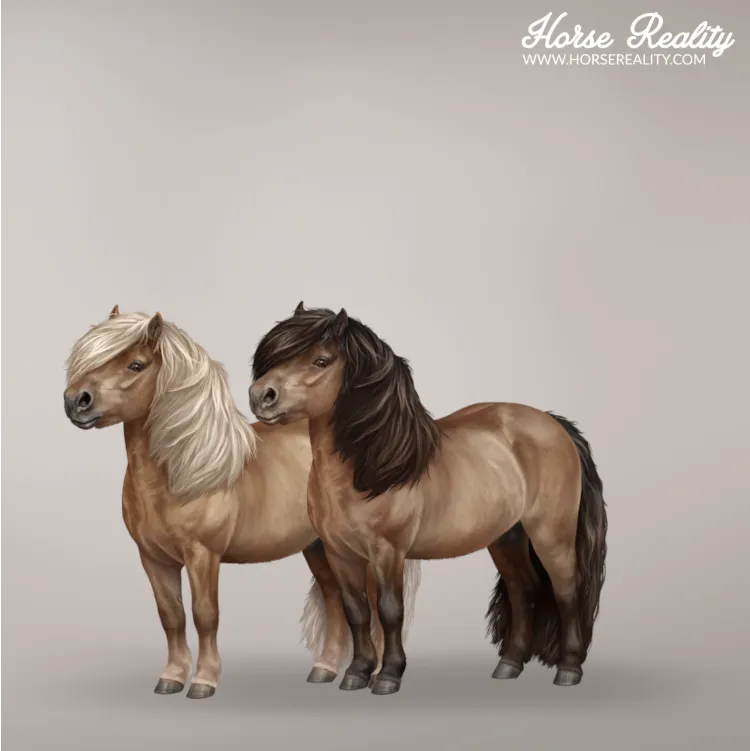
The MFSD12 gene is responsible for the mushroom coat color in horses.
Alleles
There are two currently known alleles.
The recessive mu-allele (mushroom) dilutes the coat of chestnut and bay-based horses to a sepia-toned color.
The wild-type n-allele leads to the production of normal amounts of pigment.
| MFSD12 | Color |
| Chestnut mushroom, bay mushroom | |
| No dilution | |
| No dilution |
Mechanism
Pigment cells, called melanocytes, produce the pigments in the hair and skin of horses. The production of pigments can be influenced at different stages, changing the type (black or red) or the amount (dilutions/ white patterns) of pigment that is made.

The production of black and red pigment involves several different steps. Some of these steps are shared between the two, and some are unique to each pigment type. This is why certain genes will affect all base colors, while others only affect either red or black pigment: they affect different steps.
MFSD12
The MFSD12 gene codes for the MFSD12 protein (Major Facilitator Superfamily Domain Containing 12), and has been shown to play a role in the amount of red or black pigment that is produced. It suppresses the production of black pigment, while it is required for the production of red pigment.
It is thought that the mushroom mutation leads to a non-functional MFSD12 protein and less red pigment as a result. At the same time, it increases the production of black pigment, which could explain the darker countershading on bay mushroom horses.
| Alleles | Mutation | Effect |
| Frameshift mutation | Red pigment diluted | |
| / | No dilution |
Colors
 Hannelore Roodhooft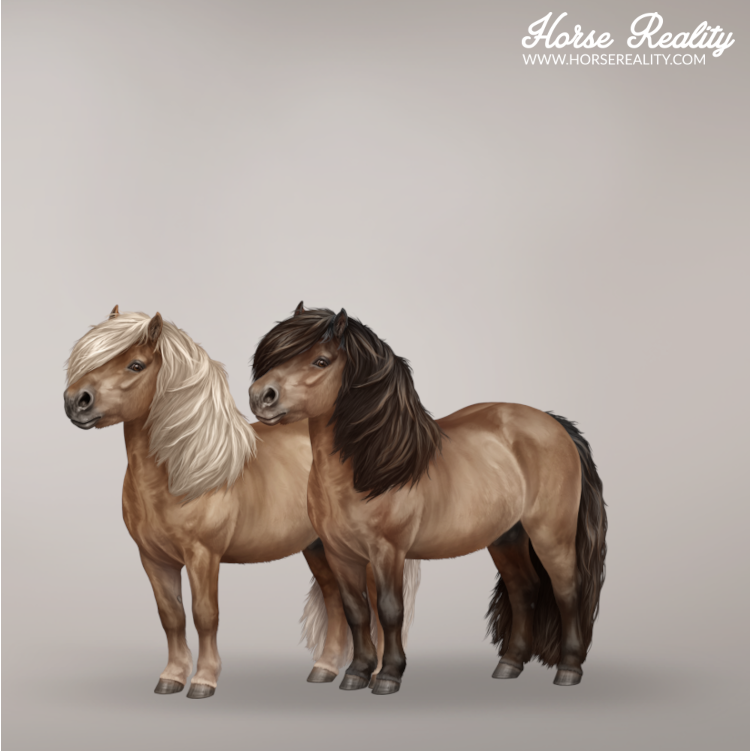
Read more:
Color genes | MATP gene | TBX3 gene | PMEL17 gene
Articles
- Tanaka, J., Leeb, T., Rushton, J., Famula, T.R., Mack, M., Jagannathan, V., Flury, C., Bachmann, I., Eberth, J., McDonnell, S.M., Penedo, M.C.T., Bellone, R.R.; Frameshift Variant in MFSD12 Explains the Mushroom Coat Color Dilution in Shetland Ponies; Genes (2019); Doi: 10.3390/genes10100826